PLA vs PETG vs ABS vs TPU: Choosing Filament for Functional Parts
Strength, heat resistance, ease of printing and cost compared, so you can pick the right filament for brackets, enclosures, clips and gaskets.
MeriForge team · · 3 min read
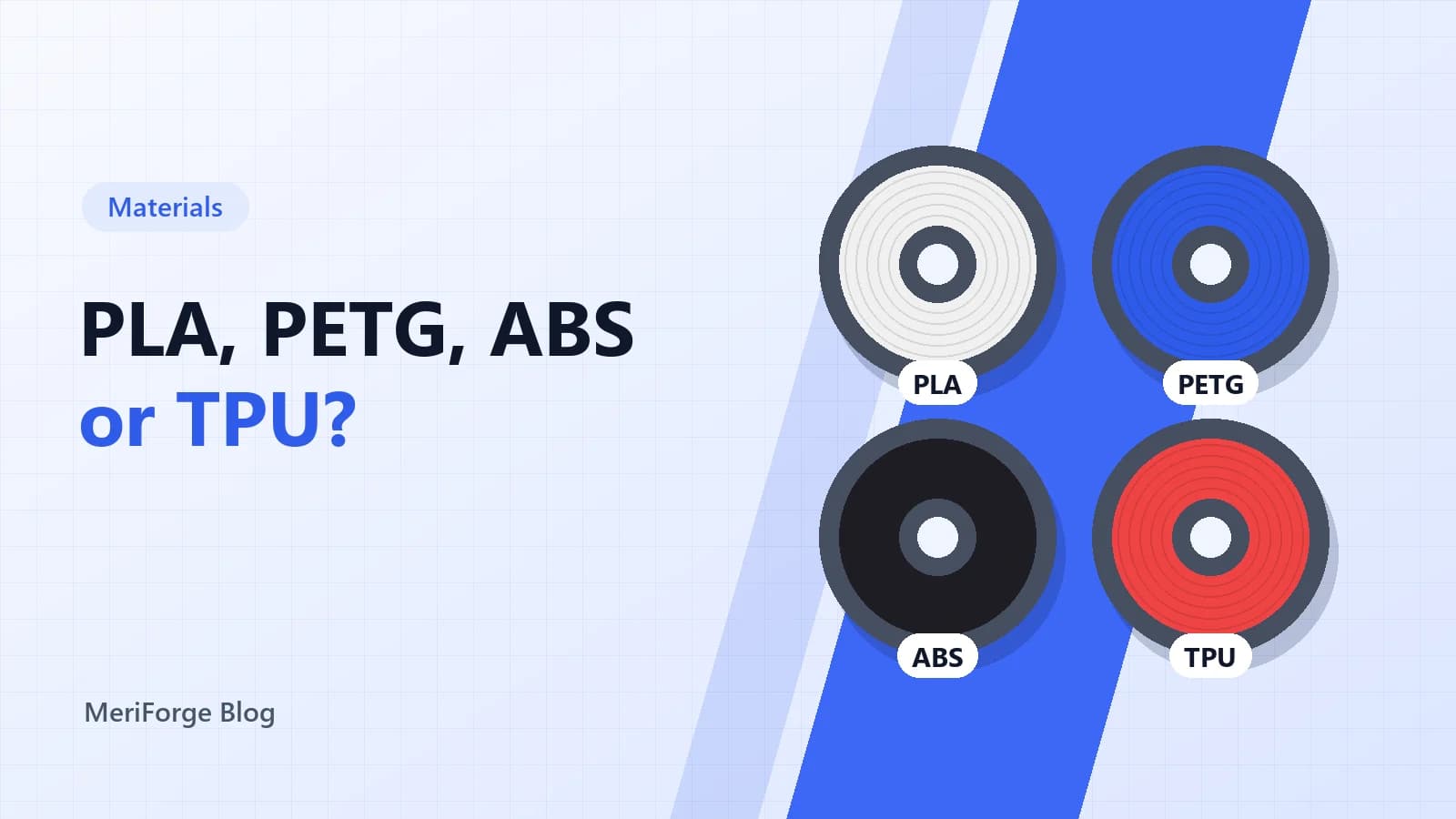
The same model can succeed or fail depending only on the plastic. A PLA bracket that is perfect on your desk can sag on a car dashboard in summer. This guide compares the four filaments most makers use and tells you when each one makes sense.
PLA: easy, stiff, but heat-sensitive
PLA is the default for good reasons. It prints at low temperatures, barely warps, needs no enclosure and gives crisp detail.
- Strengths: very stiff, accurate, cheap, wide colour range.
- Weaknesses: softens at around 55–60 °C, brittle under impact, creeps under constant load.
- Use it for: prototypes, fixtures, display models, indoor brackets, enclosures that stay cool.
"PLA+" or "tough PLA" blends trade a little stiffness for better impact resistance and are worth trying for clips.
PETG: the practical all-rounder
PETG is tougher than PLA and handles more heat, while still printing without an enclosure.
- Strengths: good layer adhesion, slight flexibility (so it bends before it breaks), better heat resistance (around 70–80 °C), good chemical resistance.
- Weaknesses: strings easily, sticks very hard to smooth PEI beds (use a release agent or textured sheet), slightly less dimensionally precise than PLA.
- Use it for: functional brackets, outdoor parts, water-contact parts, snap fits, mechanical housings.
ABS and ASA: heat resistance and finish
ABS is the classic engineering plastic. ASA is similar but resists UV, so it is better outdoors.
- Strengths: handles roughly 90–100 °C, tough, can be sanded and vapour-smoothed (ABS with acetone).
- Weaknesses: warps and cracks without an enclosure, releases fumes while printing (ventilate), needs a hotter bed.
- Use it for: parts near motors or in cars, outdoor fixtures (ASA), anything that will see real heat.
TPU: flexible and nearly unbreakable
TPU is rubber-like. It is graded by Shore hardness; 95A is the common, easiest-to-print grade.
- Strengths: flexes and recovers, absorbs impact, excellent wear resistance and grip.
- Weaknesses: must be printed slowly, prefers a direct-drive extruder, hard to support cleanly.
- Use it for: gaskets, feet, bumpers, phone cases, cable strain reliefs, vibration dampers.
Side-by-side
| PLA | PETG | ABS / ASA | TPU | |
|---|---|---|---|---|
| Ease of printing | Excellent | Good | Harder (enclosure) | Harder (slow) |
| Stiffness | High | Medium | Medium | Very low |
| Impact toughness | Low | Good | Good | Excellent |
| Heat resistance | Low | Medium | High | Medium |
| Outdoor / UV | Poor | Fair | ASA good | Fair |
Storage matters
All of these absorb moisture from the air, PETG and TPU especially. Wet filament pops and hisses, strings badly and prints weak parts. Store spools in a sealed box with desiccant, and dry them in a filament dryer or low oven when they misbehave.
How to choose quickly
- Will it get hotter than a sunny windowsill? Avoid PLA, choose PETG or ASA.
- Does it need to flex or absorb impact? TPU (soft) or PETG (tough).
- Is accuracy and easy printing most important? PLA.
- Is it going outside for years? ASA.
The design matters as much as the material. Thicker walls, more perimeters and the right orientation make any of these plastics stronger. When a design on MeriForge is made for a specific material, the description says so.